With the invasion of the Russians, water, electricity, and gas were not always available. Therefore, our father had organised batteries & a charger for us and the rest of the family. Since we usually had power outages during the day, we were able to bridge the times without electricity well. By the way, we already had central heating at that time. Of course, that didn’t work after the war, and it was already clear in the summer that this would not change for the following winter. So, one day, our father brought a portable tiled stove, which was set up in the living room. I also discovered an abandoned, plundered construction shack, which still had a so-called cannon stove standing inside. That one went into our kitchen. And I found coal in the summer on a freight train yard, which was stored to heat the locomotives. However, it was guarded, and I had no chance to get to it during the day. In other words, this was a job for a dark night – despite the guards who liked to bang around wildly with their guns. However, none of us were ever caught, and nothing could have stopped us from organising coal for the winter anyway. Once, even our father came with us. After a while, we had quite a supply to help us through the winter.
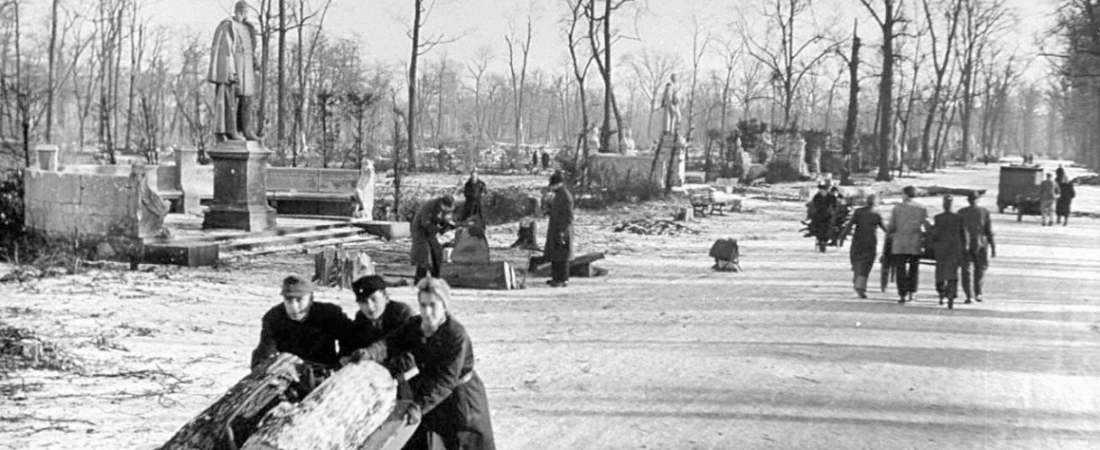
And something else helped us to get through the winter. Many neighbuoring houses were partially destroyed and uninhabited. At that time, a lot of homes were built with wood – window sashes and frames, door frames and false ceilings. Our father and I “freed” those from all remaining wooden parts until they collapsed. The whole family then had to saw firewood on a wooden trestle in the basement.
Father had soon resumed his work in the field of water treatment and began to repair destroyed plants, and – not very surprising – he was called to modernise schnapps distilleries at the request of the Russians. Some of the benefits were not to get paid in worthless Reichsmark but in kind. That was always schnapps with those distilleries.
As described in the story with the firefly schnapps, we always had to go to Potsdam to collect liquor bottles. After a while, though, a transporter full of schnapps arrived at our doorstep, and we had “money” in exchange for food and other necessary things for quite some time.
Winter came and was immediately very cold. Once again, we were lucky and saved from starving and freezing like many others. Our father had built facilities for the Russians in the coal mining area. After those got officially approved, a wagon full of coal briquettes got parked in the nearby freight yard. Father was able to find a truck that had been made roadworthy once more, which we paid for with coal. And so we trucked load after load to our home under the watchful eyes of the neighbours with their cold apartments. We shoveled the coal as quickly as possible through the cellar hatch into our basement. Now, we had more than enough “fuel” for the winter. More than that, it was a valuable medium for necessary purchases. But I can also still remember well how our father would give coal to complete strangers in emergencies.
At some point, our father picked up two rabbits – the basis for expanding our chicken farm with a rabbit farm. The rabbits were allowed to live in one of the empty neighbouring apartments, where they multiplied like rabbits should. But, to our dismay, rats also multiplied in Berlin. There were still too many dead people lying around, and a rat plague was foreseeable. One day, a fat rat attacked one of our rabbits. She just sat next to the dead rabbit and didn’t care about us. This was the beginning of the rat fight. We couldn’t help but hunt them down and kill them with a spade. That was exactly easy because – once cornered – they became aggressive. One had to be quick with the spade, which did not always happen. Contrary to my usual habits, I wore long pants that day, and after the first failed hits with the spade, the rat jumped at me and bit into my pants. It was not easy to get rid of that beast. Shaking it off was not possible, hands were not a good idea, as she tried to bite my hands. Shaking didn’t help either. I had to perform a kind of “St. Vitus dance” to throw the rat against the wall and finally finish it off.